History & Perspective
The French, The Kings And Men In Arms
Vietnam: Today's Safe Haven
On the surface, Vietnam is a great place to live for gay men. Consensual same-sex acts between men have never been criminalized in the nation's history, and there are thriving gay areas along with an incredible local nightlife scene. To be gay here isn't an issue. However, changes are still needed. There is still no formal recognition or property protections for same-sex unions, creating severe legal hurdles for local men and expats alike.
There is also the weight of tradition. Families are perfectly fine with someone else's son being gay, but local men face immense social pressure to marry women and produce heirs. This family expectation remains a heavy burden, though it is a universal reality across Asia, especially for an only child. However, the country is one of the world's safest places to live in or visit for gay men.
So, how did Vietnam become such a safe haven?
19th Century: No Law Is Law
In 1812, the empire of Việt Nam dictates absolute control from the imperial capital of Huế. The ruling court builds its entire legal and social system on rigid Confucian family dynamics. Yet, when imperial lawmakers draft the laws for the nation, they drop a tactical twist regarding male relations.
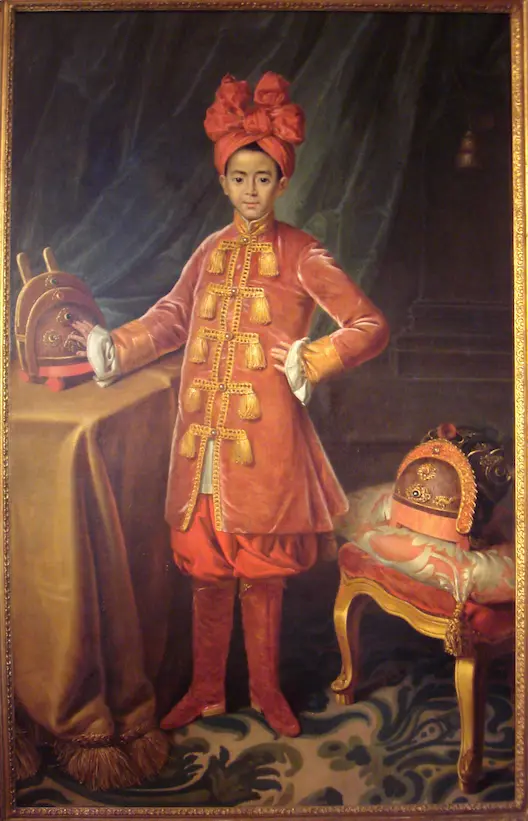 Source: Wikimedia Commons | The Emperor's son in opulent surroundings
The law, compiled under Emperor Gia Long, introduces harsh penalties for domestic violations and marital adultery under Article 332. However, legislators completely ignore intimacy between adult men. This effective legalization shows that the only real sexual insecurity at the time emanated from the execution-heavy courts of Western Europe, a historical fact documented in the Hoàng Việt Luật Lệ Registers.
Imperial judges only rule on a sexual offense if it disrupts public order or breaks a heterosexual marriage contract. This absence of law de facto legalizes same-sex relations and protects gay performers and citizens to live without fear throughout the pre-colonial era.
Sex And Power In Vietnam (1880s–1925)
French colonial forces seize control of Vietnam in the late nineteenth century while the high command suffers a panic over endemic venereal disease among troops. Terrified that soldiers will catch syphilis from female brothels, authorities ban military personnel from entering them, completely overlooking the thriving male sex trade. French officers quickly turn to handsome young local men, bringing them to military quarters under the guise of domestic servants, avoiding the political nightmare of mixed-race colonial pregnancies.
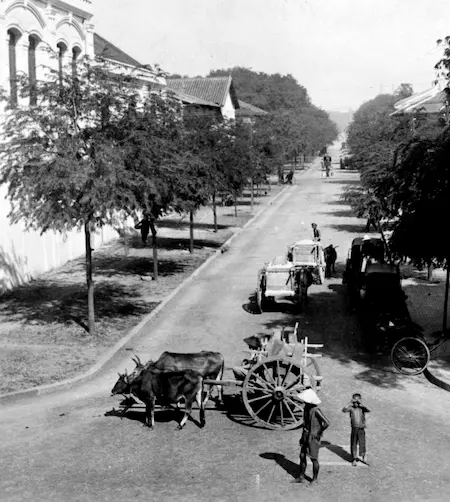 Source: Wikimedia Commons | Atmospheric view of old Saigon life
Archival research by scholar Frank Proschan shows these arrangements often transform into genuine romances, with soldiers paying monthly stipends to their local companions. The colonial government refuses to criminalize this behavior because doing so would openly question the military's masculinity and weaken imperial authority.
This MSM culture reaches the very top of Vietnamese royalty. During the reign of Emperor Khải Định, from 1916 to 1925, court records preserved by historian Nguyễn Đắc Xuân confirm the monarch despised the company of women. He famously clutched his heavy silk robes tightly to his sides so he never had to touch his twelve forced concubines.
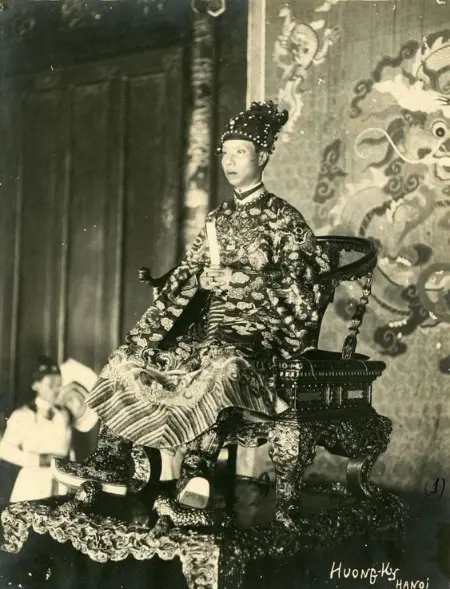 Source: Wikimedia Commons | The Emperor on his imperial throne
Instead, the king spends his nights locked away with a handsome young bodyguard named Nguyễn Đắc Vọng, who enjoys rapid military promotions as royal rewards. The emperor even bans women from the imperial opera troupe, preferring attractive young men to wear pink makeup and silks for his private entertainment. Today, the modern state happily rakes in millions of tourist dollars from his flamboyant porcelain tomb in Huế while straight-washing the history of the gay emperor who ran an empire from the arms of his male lover.
The Other Vietnam War (1975–1986)
During the conflict, the American military command brings intense anti-gay paranoia straight to the jungle, weaponizing regulations to purge any soldier suspected of same-sex attraction. Yet, on the chaotic streets of US-controlled Saigon, a massive double standard thrives. American cash fuels a sprawling wartime nightlife where gay GIs and local men mingle in unregulated spaces.
Military officials report at least 18 gay establishments operating openly, including steam baths, bars, and coffee shops. The southern government keeps its traditional legal silence intact. The US military controls regional politics, but they cannot stop the organic vice economy growing around their own dollars.
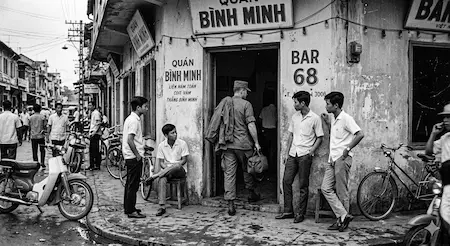 Source: GWN | Representation of a secret wartime gay bar in Saigon
April 1975
The North Vietnamese Army captures Saigon as US officials evacuate the city in a massive humiliation of Western power. The incoming regime views the southern capital as a den of capitalist decay, launching aggressive campaigns under the banner of eliminating social evils (tệ nạn xã hội). While the state never explicitly writes sodomy bans into law, authorities use this all-encompassing social evils classification to justify arbitrary arrests, herding gay men into re-education camps alongside sex workers and drug addicts.
Out From The Shadows: 1986
For decades, local officials brand homosexuality as a decadent Western disease and a direct symptom of imperialist corruption, using the excuse to raid private gatherings and force the community underground. The modern scene only begins to break free in 1986 when severe financial stagnation forces Hanoi to find pragmatic economic solutions. The state drops its manufactured moral panics to let the organic gay economy build what has become a massive, irreplaceable pillar of Vietnam's international tourism sector.
Perspective
History tells of an accepting society and the gay community have always needed that special sense of security. Vietnam provides that, but the absence of legalized civil partnerships for local gay men is a strategic failure of the state. Why? Partners have no legal right to visit their loved ones in hospitals. Their finances are not recognized as a family unit, meaning no 'family' tax breaks, house ownership, or inheritance. The result leaves couples financially insecure, imposing a barrier to opening a business or making wider investments in the economy. Most gay couples don't have children. They have more money to spend. It's an economic own goal.
In terms of exploiting the global gay tourist market, Hanoi is totally nailing it. This demographic is predominantly peaceful and self-contained, representing zero threat to the ruling regime. When the state gets out of the way, our community generates an economic goldmine of tourist revenue, multiplying the financial rewards of recognizing gay partnerships.
Thailand provides the traditional heavy-weight competition in the region and recently legalized equal marriage. However, most tourists see beaches and bars, not marriage certificates. Decades of relying on being a cheap destination to attract rowdy tourists have pushed Thailand's highly educated, urban population to a boiling point, triggering nationwide tourist fatigue. Twinned with skyrocketing costs and the glass-fronted venues of a corporate gay scene, travelers are rejecting this toxic legacy in search of something welcoming and authentic. Vietnam's true smiles capture Thailand's once untouchable market, transforming its major cities and beaches into the most exciting, organic hubs for MSM travelers in the region.
Vietnam weaponizes gay acceptance into pure economic power. Other socialist states might not admit it, but the proof is undeniable. Hanoi discovered an essential truth: it is impossible to fight a prosperous, universally liked population. So the state got out of the way. Look what happened. Local men became an irreplaceable part of daily life, sending a powerful message rippling across the world.
Authoritarian regimes like China and Russia hear it loud and clear: Stop manufacturing a fake enemy and grasp the economic advantage.
The only threat to this message is the one we present ourselves. The loud street theater and rainbow flags at violent protests, the 'Queers for Palestine' banners, and radical demands provide perfect ammunition for rogue regimes to terrorize their local gay populations. This outside noise needs to change. Pride should mean respect for a society that accepts us, not picking exhausting fights with religious institutions. All countries are inherently insecure, requiring careful nurture to build basic trust rather than aggressive rhetoric that is becoming painfully boring. Have you noticed in the West? The public are getting tired of us. That is dangerous.
The gay community must be seen as normal and a welcome addition to the wider populace to dissolve the fake fear that populist leaders exploit.
Once regular straight citizens realize that gay men pose no danger to their daily lives and families, governments lose their ultimate distraction. Trying to force religious conservatives into embracing gay marriage is a critical mistake. We only need civil partnerships. A basic legal contract.
Since Hanoi already reaps massive economic rewards from its organic gay scene, the government needs to drop its leftover post-war paranoia, follow the pragmatic legislative talks of neighboring Cambodia, and formally open the door to civil contracts that bring even more revenue to the state.
The Source Files
⚠ General Reading Advisory
Wikipedia and community hubs are open-source and subject to change. For peer-to-peer academic research pages, consult our verified 'blue' sources below.
Open General History Archive Hub19th Century: The French Colonial Medical Archives
Journal of the History of Sexuality Records Johns Hopkins University Press Vault – Meticulous research detailing the French military medical panic and domestic male intimacy records in colonial Tonkin.How to Find It: Access the digital archives database and query Frank Proschan's specific peer-reviewed study on colonial surveillance loops.
19th Century: The Imperial Legislative Codes
Library of Congress East Asian Law Archives Library of Congress Digital Vault – Verified penal records and criminal statutes from the pre-colonial Nguyen Dynasty era.How to Find It: Search the main international legal collections index using the query phrase for the 1812 Hoang Viet Luat Le legal codes.
20th Century: The Hue Imperial Scribe Ledgers
Nguyễn Đắc Xuân Court Repositories Tales of the Nguyễn Royal Court – Documented court translations and verified local historical testimonies regarding the daily schedule and private life of Emperor Khải Định.How to Find It: Open the modern digital history archives and search for the chronicled logs compiled by historian Nguyễn Đắc Xuân.